

Online newspaper based in Matera
EcocNews is registered at the Court of Matera in the press register n. 2/2021
Editor in chief: Mariateresa Cascino. Founder and editorial director: Serafino Paternoster
via San Francesco, 1 - 75100 Matera (Italy)




Ecocnews Founder, Journalist, repentant jazz guitarist, music critic and film lover.
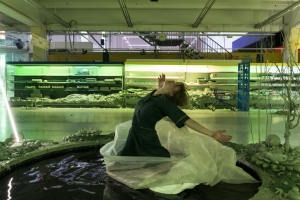
Calling it a theatre performance would probably be too limiting. Describing it as an immersive performance is more accurate, yet still insufficient. Faravid’s Land, staged in the abandoned premises of the former Raksila supermarket, belongs to a category of contemporary works that seek to redefine the relationship between artist, space and audience by questioning one of theatre’s founding principles: control over the viewer’s gaze.
This is the third instalment in the EcocNews series dedicated to the Spanish cities shortlisted as candidates to become the European Capital of Culture in 2031. Following Cáceres and Granada, today’s interview focuses on Las Palmas de Gran Canaria.The European Commission’s jury will announce the winning city on 3 December.
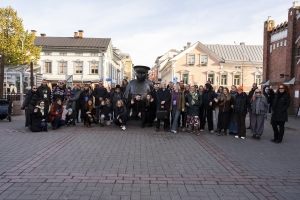
In Oulu, in Europe's far North, 2026 is not just a year of celebrations. It is proof that investing in culture can transform a city and push back the cold by warming up human relationships.
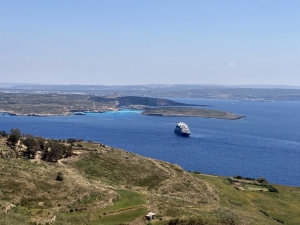
In 2031, Spain and Malta will each host the European Capital of Culture. The decision for Spain will be made on 3 December. The panel will have to choose from four cities: Cáceres, Granada, Las Palmas de Gran Canaria and Oviedo. As for Malta, the panel made its decision in recent days. The choice was not entirely a foregone conclusion, even though only one city had made it short-listed. Victoria–Gozo has been designated as the European Capital of Culture 2031.
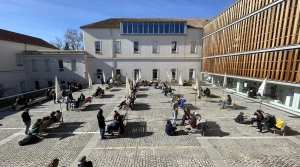
This is the second instalment of EcocNews’s series on the Spanish cities shortlisted to become the European Capital of Culture in 2031. Following on from Cáceres, today’s interview is with Granada. The European Commission’s evaluation panel will announce the winning city on 3 December.
The European Commission has recently presented a proposal to reform the European Capital of Culture (ECoC) initiative to the European Parliament and the Council of Europe, considering that the current rules will come to an end in 2033.
On 10 September 2026, the European Commission adopted its proposal for the new legal framework of the European Capitals of Culture Action from 2034 to 2047. The action will be negotiated with both the European Parliament and the Council. The link at the end of this news.
What remains of a Capital of Culture once the spotlight fades? That is the question running through the *study by Madoka Sugawara, Tomoyuki Mashiko and Susumu Kawahara on Leeuwarden-Friesland, the Dutch city that held the title of European Capital of Culture in 2018.
Nova Gorica and Gorizia are still all dressed up, as elegant as ever, but in a shade somewhere between green and turquoise that is still clearly visible on the branded buses, in shop windows and on information pillars.
With the advent of artificial intelligence, we are on the cusp of – or rather, in the midst of – a new industrial revolution which, compared to its predecessors, is unfolding at a far greater pace, reshaping the rules and our perspective on the world around us. Artificial intelligence is influencing every aspect of our lives, from the smallest to the largest, with consequences that are currently difficult to imagine.
Online newspaper based in Matera
EcocNews is registered at the Court of Matera in the press register n. 2/2021
Editor in chief: Mariateresa Cascino. Founder and editorial director: Serafino Paternoster
via San Francesco, 1 - 75100 Matera (Italy)